5 great ecological inventions for sustainable living
There are many small and large ecological inventions, all of them with an incredible impact on the environment. Discover 5 inventions that can change


It is difficult to make a list of those most striking or surprising ecological inventions, since there is a wide variety and all of them satisfy a need in an environmentally friendly way.
It is possible to maintain our comforts without posing a risk to the planet. The following inventions demonstrate this capability. Discover them!
Warka Water Towers
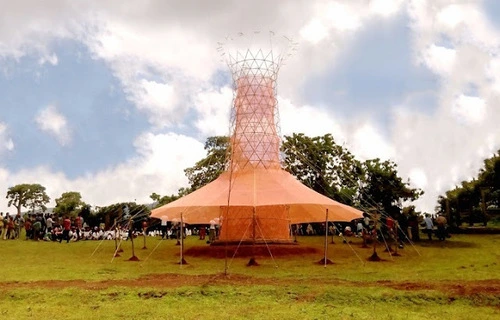
Thanks to the ingenuity of the architect Arturo Vittori, arid areas of Africa, such as Ethiopia, Togo and Cameroon, have a 100% ecological system that allows them to obtain water.
Warka Water It is an ecological invention that consists in transforming rainwater, fog, dew and moisture into drinking water. How? Through a simple system, built with bamboo and biodegradable plastic, that captures moisture and directs it to a hygienic holding tank.
This method allows more than 100 liters of water to be collected daily, which is a viable solution to end the risk of drought in the world. Although this invention has been in operation since 2015, it is very little known and its expansion is small.
CO₂ ink
In the laboratories Graviky Labs, in India, they have been converting elements harmful to the planet and health into harmless products for daily use. This is the case of inks created from CO₂ in cars.
Thanks to a device that is placed in the mufflers of car exhaust pipes, carbon particles are trapped and once a sufficient amount is collected, it is processed to turn it into pen ink.
Each pen contains the equivalent of 40 minutes of emissions generated by a car, so the reduction to the atmosphere is very high.

Renewable energy warehouse
The main problem with renewable energies is the difficulty of storing them. Currently, we find solar batteries on the market, which allow us to store the energy produced by solar panels. However, it's an expensive option and they have storage limits.
This is why Google is working on the Malta project, with the aim of offering an alternative to batteries. Its purpose is to create an efficient system that allows us to store renewable energy on a large scale in an economic way.
The proposal is based on a novel system involving hot molten salts and cold antifreeze liquid. Both elements would serve to store energy, which would later, through a motor, be converted back into electricity.
Eco-friendly concrete
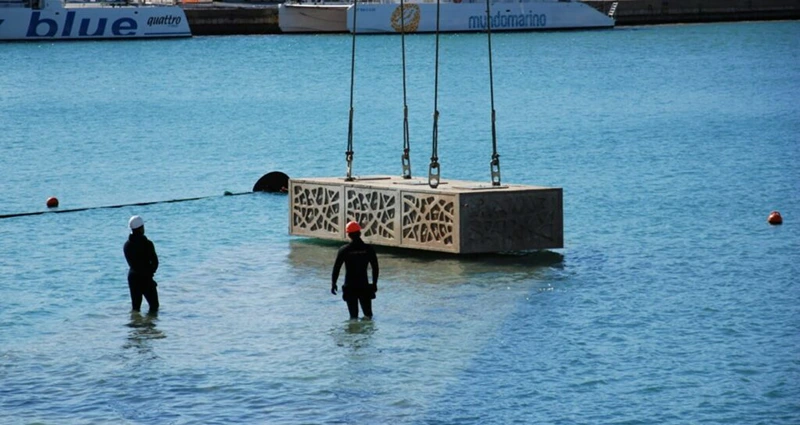
The lack of biodiversity in ports, and the damage they cause to the marine ecosystem, has always been commented on. Biologists Ido Sella and Shimrit Perkol-Finkel wanted to provide a solution to this problem, creating an innovative design that allows functionality and enhances life in the seas.
The pieces are manufactured with a material that emerges from concrete, altering its components, and the design imitates nature to encourage animals and plants to settle on its surface. In addition, this feature makes them carbon sinks that absorb CO₂ on a daily basis, over the nearly 100 years of the infrastructure's lifespan.
East ecological concrete it has already been applied in ports such as those of Malaga, Vigo or Mallorca, or in the submarine cable between Lanzarote and Fuerteventura. With this invention, its creators have been finalists in the European Inventor Award 2022.
Yucca starch bag
One of the most serious environmental problems is plastic, since it takes years to decompose and ends up damaging ecosystems around the world.
Faced with this alarming situation, Kevin Kumala, a young Balinese biologist, has launched his ecological invention: bags of cassava starch. Unlike plastic, which takes hundreds of years to break down, This biodegradable bag takes 100 days. Without a doubt, a viable solution that would put an end to the serious plastic problem.
Ecological inventions, the solution for climate change
There are many small and large ecological inventions that are being developed today. All of them have an incredible impact on the environment. However, most of them don't end up being commercialized or expanding as they should.
The world urgently needs change, so any invention that brings about a reduction in emissions and environmental damage is welcome. As in the case of ecological cities, which add many innovations to reduce the carbon footprint.
5 great ecological inventions for sustainable living
Green architecture: what it is and what are its characteristics